

Appendix 2R; Grow in Maturity - Walk in Love
Erik Erickson was a German-American developmental psychologist who made the term “identity crisis” popular. The depth of his studies brought him to realize that a person's psychological needs don't stand alone. In Erickson’s theory of step development, he sites eight key virtues (not vices) that are necessary for healthy, balanced, psychosocial maturity in life. As summarized by McLeod, S. A. (2018, May 03), Erickson theorized that if any unhealthy event (labeled as a "crisis") halts the development of one of these basic virtues, the person will not incorporate the true expression of that virtue into their behavior, resulting in their own stagnation and frustration due to the inability to develop healthy relationships in a social world. In step six, he points to love being one such virtue. A healthy definition of love comes from the resolution to the “trust/mistrust” crisis in stage #1 (necessary to the successful development of hope).
-
See picture below and/or revisit Appendix 1C for details on Erickson’s step theory, centered on the epigenetic principle; a psychological/social impact on genes without altering the original DNA structure.
This is where you see Erickson starting to intermingle psychological and social needs into conditioned behavior and theorize that successful development of basic virtues will build upon each other to lead a person
to manage a healthy, functional personality. Notice that learning to trust is the building block of hope which propels continuous learning so the rest of the virtues can develop unscathed. Learning to "trust" (or not too) has its root formed in you at a very early age by a mother/father figure that meets your need for security (physically as well as emotionally). Be the parental example good/right or bad/wrong, that example will lay the groundwork for your personal mental picture of trust. You'll create a belief about the virtue of trust and this belief will affect all areas of your life as you grow, making experience your ultimate teacher .
-
Appendix 1D for more on truth, another essential ingredient to hope.
By taking a closer look at the "crisis" associated with each step, you'll see a connection between the virtues and the quality of life you experience because of your view of reality (perception):




Love is a fundamental virtue that motivates behavior, a topic in which Bible and academic scholars agree.
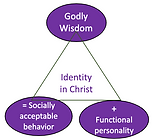
Learning to love yourself happens in the first five steps of this Erickson's theory but then the steps shift focus to move on to loving others, wisely, so you rightly apply love (discernment) habitually, growing into a functional, altruistic, personality (1 Corinthians 14:20, 1 Peter 2:2). The ability to see past yourself forms as you grow in confidence and can leave behind a me first attitude because you are secure in yourself. A healthy but accurate love and acceptance of yourself (because of a new identity in Christ) gives you the foundational security to love God while authentically loving your neighbor as yourself (James 2:8, Ephesians 3:17-19, 1 John 3:18). It is this security from a trustworthy relationship with the Triune God that boosts your confidence and reduces the anxiety associated with the vulnerability needed to express authentic actions of love. For an example, a crisis in step six of your identity development results in shallow relationships. When you can't depend on others to help you through life, you shun intimacy and sacrifice potential relationships for independence and control which blocks the seed of trust (which blossoms into love).
-
Read Appendix 2N for more about choosing to be vulnerable yet secure rather than independent yet unfulfilled.
Love is the message of the New Testament (Galatians 5:6, see https://www.gotquestions.org/law-of-Christ.html). God’s love spoke when He sent Jesus Christ to save humanity (John 3:16). Jesus Christ’s love spoke through His obedience to God’s plan because His love for God surpassed His own self-love for His life (John 14:31). Jesus faced all the typical human emotions and temptations that are common to man yet remained sinless because He loved God (John 15:9, 1 Peter 2:22). Herein lies a major difference in theory behind Christians and secular psychologists. Christians believe or have faith in God and this underlies each of Erickson’s steps, pointing to faith producing wisdom and giving you, as a Christian, all you need to navigate through the potholes of life. Christians today also have the New Testament which plainly paints the picture of Jesus relying on his faith to walk the road that God designed for Him. The Bible doesn’t reveal the specifics of Jesus childhood except to say in the gospel of Luke 2:41-2:52 “… Jesus increased in wisdom and in stature and in favor with God and man”. While we don’t read about Jesus again until He was 30 years old and began His public ministry, what we can read about is how He modeled what it is to walk in love (Luke 3:23, 1 John 2:5-6).
Psychologist Erickson also determined that you come to understand what a healthy and balanced expression of love looks like in the age range of 18-40 years old (1 Corinthians 13:11, Ephesians 1:12-13). Developing this mature love happens, not with age, but with acceptance and understanding of God’s position in your life. Knowledge of God is the fundamental virtue you need, even before Erickson’s first step, because the virtue FAITH, not hope, structures your life. It brings you a secure, passionate and grateful feeling that motivates you to give it away to others. A mature Christian love is demonstrated by the willingness to be persistent and resilient while acting on hope and confidence (Philippians 1:9-11, 2:1-9, 1 Corinthians 15:58).
Erickson’s stages theory does, however, clearly point out the connection between love and wisdom. In Christianity, the developmental steps lead to not only your wisdom and insight but your growth into true altruistically selfless behavior seen by acts of kindness to others. This is why a Christian stuck in addiction is advised to look at the 12 steps in Alcoholics Anonymous pictured as a cycle. Step 12 says to "give it away" so you can go through the steps continuously to intentionally shape not only your new normal lifestyle, but someone else's.
-
Review Appendix 1B with this perspective in mind.


2
2
The Holy Spirit is the gift from God that secures your future, but also equips you for walking in love today. Once you learn to trust and love God, your secure relationship with Him enables you “to give it away” to others without feeling anxious because you have been released from the false security of what is called, "an illusion of control" (James 4:13-17, Proverbs 16:9, 1 Chronicles 22:19, 1 Corinthians 13:13)! This realization is freeing yet binding. It’s the emotions of love and gratitude towards the God who loves that motivates Christians to sacrifice their own wants for obedience so they can realize their security in Christ (Romans 13:8-10, 1 Corinthians 13:13, 14:1, 2 Corinthians 4:11). When you continually add to your knowledge of God, you fuel your motivation to walk in love (2 Peter 1:2-10, Philippians 1:6). Choosing to focus on others enables you to move from self-gratification to self-sacrifice (see
scriptures cited in https://www.gotquestions.org/Bible-self-sacrifice.html).
-
Read more about how to ShinE God's humble, self-sacrificing love, given to you to give away to others in Appendix 2U, Appendix 2S, and Appendix 2T.
-
Read more at https://www.faithandpractice.nz/index.php/2022/07/19/the-name-of-god-is-love/


A note about how you walk in love as a Christian
The Holy Spirit is the wisdom and counsel of God, imparted to you when you became a Child of God (Isaiah 61:1-3, 60:1-3, 11:1-2). When you respond to God with humility and faithfulness, you will choose to apply the Spirit's power (like self-control and patience) to defeat the temptation to sin (or be fooled by the illusion of control) and as a result you can achieve the peace and joy of the Lord (John 16:33, Isaiah 26:3, 2 Thessalonians 3:16, 1 Thessalonians 5:23, Galatians 5:22-23). It's being mindful of God that you see a cycle of gratitude pulling you towards God, continuously, in good times and bad, because of your knowledgeable hope and understanding of the Triune God in you, not your worthiness.
A note about worthiness
Basing actions on your own opinion of your worthiness results in extreme behavior generated from either an over or under-inflated sense of self producing pride and blinding you to gratitude. A knowledgeable faith brings you the courage and freedom to be satisfied with doing only the next right thing, and leaving the results of the bigger picture in the hands of God. (This means that God will honor your Godly goal, but you will have to trust Him every step of the way and follow His plan to succeed. God does not change His mind (Numbers 23:19). Trusting God not only gives you the self-confidence you need to pull you forward towards to your new normal, but it gives you the shield of confidence to love others; to stand strong and to march forward because of a realistic and confident view of God and yourself (Jeremiah 17:7, Hebrews 10:23, 13:6, Ephesians 3:11-12, 2 Timothy 2:1, Joshua 1:9).
-
Listen to the song by Pat Barrett, "Build my Life" @ https://www.youtube.com/watch?v=QZW4_8_zCBE
-
Read more about growing with the Holy Spirit rather than grieving Him @ https://jesusplusnothing.com/series/post/Isaiah63.
-
Reinforce your idea of God's sovereignty in light of Numbers 23:19 @ https://www.gotquestions.org/God-change-mind.html


This is what it feels like when you make daily decisions consistent with the truth of God - you create a new normal life in Christ (Matthew 6:33, John 15:4). King David, loved God, not perfectly but intentionally; see how his attitude of faith sparked hope and trust in God. His centering point was the truth of God (Psalm 101:1-4):
I will sing of steadfast love and justice;
to you, O Lord, I will make music.
I will ponder the way that is blameless.
Oh when will you come to me?
I will walk with integrity of heart
within my house;
I will not set before my eyes
anything that is worthless.
I hate the work of those who fall away;
it shall not cling to me.
A perverse heart shall be far from me;
I will know nothing of evil."
Human beings live in the mercy and grace of God. (Both, not one at the expense of the other.) Nothing and no-body in the world performs perfectly and we aren't expected to by God. God judges your heart's intentions and His acceptance of you encourages you to share His mercy and grace with others (Ephesians 1:6-8, 4:1-3). A heart of integrity to God responds to themselves and others with kindness, goodness, and gentleness because faith in the truth of God fuels hope and ushers in your willingness to act with self-control and patience as you wait on God to uncover the next right move according to His timing and plan (Psalm 32:8, 130:5-6, 33:20-22, Proverbs 16:9, Isaiah 30:18, Philippians 4:6-7, James 5:11). Faith is expressed in both attitude and actions by praising God and deciding to imitate His ways (James 1:22, 1 John 3:18, Hebrews 11:1, Galatians 6:7).
