

Appendix 1I; Cycle of Sin
God's supremacy affects all people, whether His authority is recognized or not. A humbled Christian understands that sinful behavior leads to negative and/or unproductive spiritual, psychological and physical consequences because of the universal law laid out in Galatians 6:7 - you reap what you sow in this life (1 Kings 18:18). While Matthew 5:45 and Ecclesiastes 9:11 point out the fact that time and chance do happen to all people, when you stick to God-driven (as opposed to self-driven) actions, your right thinking and behavior reduces negative consequences from overtaking your life. You gain the knowledge of sin when you become aware of the Holy God of the Universe. By reading His definition of sin in key Biblical scriptures; 1 Thessalonians 2:4, John 5:30, Matthew 6:33, Hebrews 11:6, and Romans 8:5-8, 12:1-3, you can recognize sin's temptation and choose to walk away from it. Sin is a rebellion against God's authority in a certain area of your life; an action taken that pleases yourself instead of selecting a behavioral option that pleases God. Trust acts!
-
Sin Biblically defined in it's simplest form: James 1:13-15, 1 John 2:15-17.
-
God's antidote for sin: Colossians 1:19-22, James 1:25.
When you look at the Old Testament of the Bible, you see not only God turning situations around for the good of His people, but you begin to recognize a trend in human behavior; the temptation to have what you want when you want it. Unbounded desires redirect your view away from God which leads you into a cycle of sin because the urge to fulfill rather than restrain a sinful desire may produce short-term satisfaction but leads also to many unwanted and even unanticipated long-term consequences (Judges 2:10–3:6). Your independence from God leads to despair and then to repentance when you are finally willing to trade instant gratification for what you want most, not simply what you want now (Luke 11:4, Hebrews 3:13, Proverbs 14:12). Shifting your thinking will lead you to look for a more productive habit. Rather than think about it as giving up a sin, which takes will power, when you willing receive Christ as Lord, your Spirituality shapes your mentality so you no longer think in terms of abstinence but in terms of habit replacement (Luke 11:24-26).
-
Nehemiah chapter 9 also talks about the cycle of sin and God's consistent response to your repentance (9:16-21, 26-31).
The cycle of man’s sin and God’s merciful response:
Deuteronomy 4:25-31, 31:20, Judges 2:18-20, Isaiah 55:6-7
Christians exit the practice of sin here
(1 John 1:6, 1:8, 3:8-9).
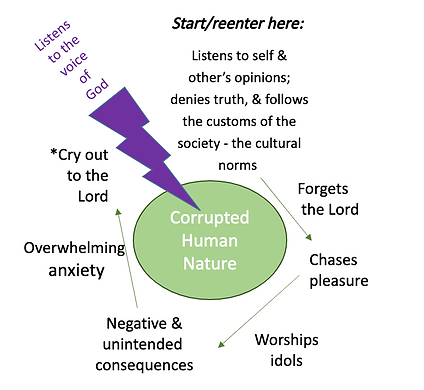
Man’s free will and the sovereignty of God live together in tension only for a temporary period of time until you've replaced your sin habit with the habits that reflect the will to do God’s good pleasure (Philippians 2:13, 2:2-9). The beginning of your transformation into a Child of God happens with awareness that causes you to reassess your thoughts. From a change in your thoughts you can develop a new gratitude and honor for God, the giver and sustainer of all life which causes a new attitude
https://www.openbible.info/topics/god_is_the_giver_of_life). When your attitude lines up with your thinking, you want to change your bad habits. This alignment produces cognitive consistency so you'll be motivated to use physical actions to show your belief. While sin may always hold some type of attraction to you, by your decision to honor God you can redirect your thoughts so they are consistent with your attitude and together they will produce like behavior that proves your decision to honor God by learning and willingly following His ways.
God's love breaks into your cycle of sin when you call to Him
(Psalm 107:19-22, Judges 2:19-22).
The difference between a fool and a wise man is what he chooses to learn and do (Jeremiah 9:23-24). Disciples of Christ learn to balance the fear and love of the Lord by allowing the awe of God to motivate trust, love, and obedience as discussed in the Art of Self-mastery section entitled "....Triggers ... Obedience ...". It's this proper attitude that influences your behavioral choices so you are responsible and can achieve what it is you set your mind to (1 Peter 1:13*, Luke 12:14-15). Being at peace in this life is found when you rest in Christ, meaning that your renewed spirit, soul (mind, will, emotions & imagination) and body work together in agreement. A Christian acts with intention; your spiritual intuitiveness signals your body to respond to your mind - resulting in physically walking out the standards of the Triune Christian God in your daily life. Being transformed by God is a both a decision and a process that comes with time, understanding and maturity so you can be identified as a Christian (Appendix 2R and Appendix 1S). Jeremiah 9:23-24
-
*Other key scriptures on walking in the maturity of your faith; 1 Thessalonians 2:11-1, 5:23, Philippians 2:12, 2:5-8, 1 Corinthians 14:20.
Christ died for all on a cross*, but only those who receive this gift with gratitude will become mature children of God in Spirit, soul and body (Ephesians 3:19, 1 Thessalonians 5:23). Christ's Holy Spirit works within you to motivate your transformation; instantaneously in your spirit but progressively with your soul and body. It's God who transforms your heart, but it will take time for you to learn the proper boundaries so you can begin the process of loosening your grip on sin (Romans 6:6) and learn to implement new behavioral habits that honor God (Ephesians 2:4-5, 4:22-24, 2 Corinthians 5:14-17). Replacing sin habits with the knowledge and the practice of Godly habits develops character integrity from being "in Christ" (2 Peter 1:5-10, Appendix 2G).
*What is your cross? (Pride, independence, public approval?) Are you willing to carry your cross and ShinE the light of God's love in you, a willing vessel, so others can see and find this gift too (Matthew 13:44-46, Luke 9:22-23, Colossians 3:10, 1 Peter 2:12)?
-
Read more about self-sacrificial love in Appendix 2T.
2
